about me
Practice
Titles
For me, the birth of a title often begins with the desire to summon a word I do not yet know. I search, I dig, until I find the word that resonates, that resists, that teaches me something, and that can shelter a form of poetry. The same process guides the making of my works. I like to let my readings, my relationship with architecture, conversations, and the exchanges of everyday life settle within me, each becoming fertile ground from which desires and necessities quietly emerge: the need to begin working, to search for forms, and to find the tools capable of giving them substance.
Beauty
I am not afraid of the word beauty. I seek it, I need it, and if I can evoke its presence, I am happy. I also like it when what appears is not immediately grasped. I invoke forms that recall more than they describe. My works—even those in two dimensions—remain close to sculpture. I draw libraries, formal alphabets of buried memories that I try to summon. I compose historical and geographical strata that complement one another, contradict one another, and reverse one another. Instability is my element.
Narratives
My love of the narratives woven through my work has a dual origin. When I was in my twenties, I had the extraordinary opportunity to live among Pierre Bourdieu's library, occupying his remarkable apartment alongside Marie-Claire, who shared his life. The walls of the space I lived in, on the third floor, Pierre's former study—formed cliffs of books surrounding me. I was twenty years old and discovering that thought itself could emerge through the organization of books: art alongside science, manuscripts beside literary works. It was profoundly moving to inhabit such an architecture of thought. A few years later, when I met Norbert Godon and, through him, discovered Aby Warburg, an impulse that had first been intellectual gradually began to take shape through new artistic productions.
Dust/Grisaille
Some time ago, my work revealed itself to me in a different light. I had forgotten the stories from my father's family, who worked in the coal mines of northern France, and those of my childhood in La Mure, in the Isère region. The slag heaps, the spoil tips, the pieces of coal resting on shelves, the physical sensations evoked by descriptions of descending into the shafts: the heat, the candles, the blackened lungs, and the timber structures supporting the galleries. On my mother's side were the blast furnaces that filled the windows of my childhood holidays, their cries, the showers of sparks that sometimes lit up the sky, the stories told by my grandfathers, steel, coal, pig iron, and the immense force of metallurgy. I think of them, of their gestures, their communities, extraction, matter, dust, fusion, and those monumental architectures: cold, beautiful, and strange. Today, this resonance seems to me to be an essential part of what binds me to that layer of dust, poised on the threshold between what separates it from the inside.
Habitats
I live and work between the Plateau d’Hauteville and Paris. I feel at home in both places. The Haut-Bugey has a landscape that, for the first time, made me feel that I belonged somewhere. There are cliffs, forests, springs, dark nights, luminous skies, and the open horizon of a mountain plateau. Paris has a different pulse, a different complexity: anonymity, encounters multiplied by sheer numbers, walls, details, small streets and great arteries that can appear differently each time you pass through them. I also value the distance between these two places, the possibility of moving from one to the other, and what that movement keeps alive.
Craftsmanship
Glass
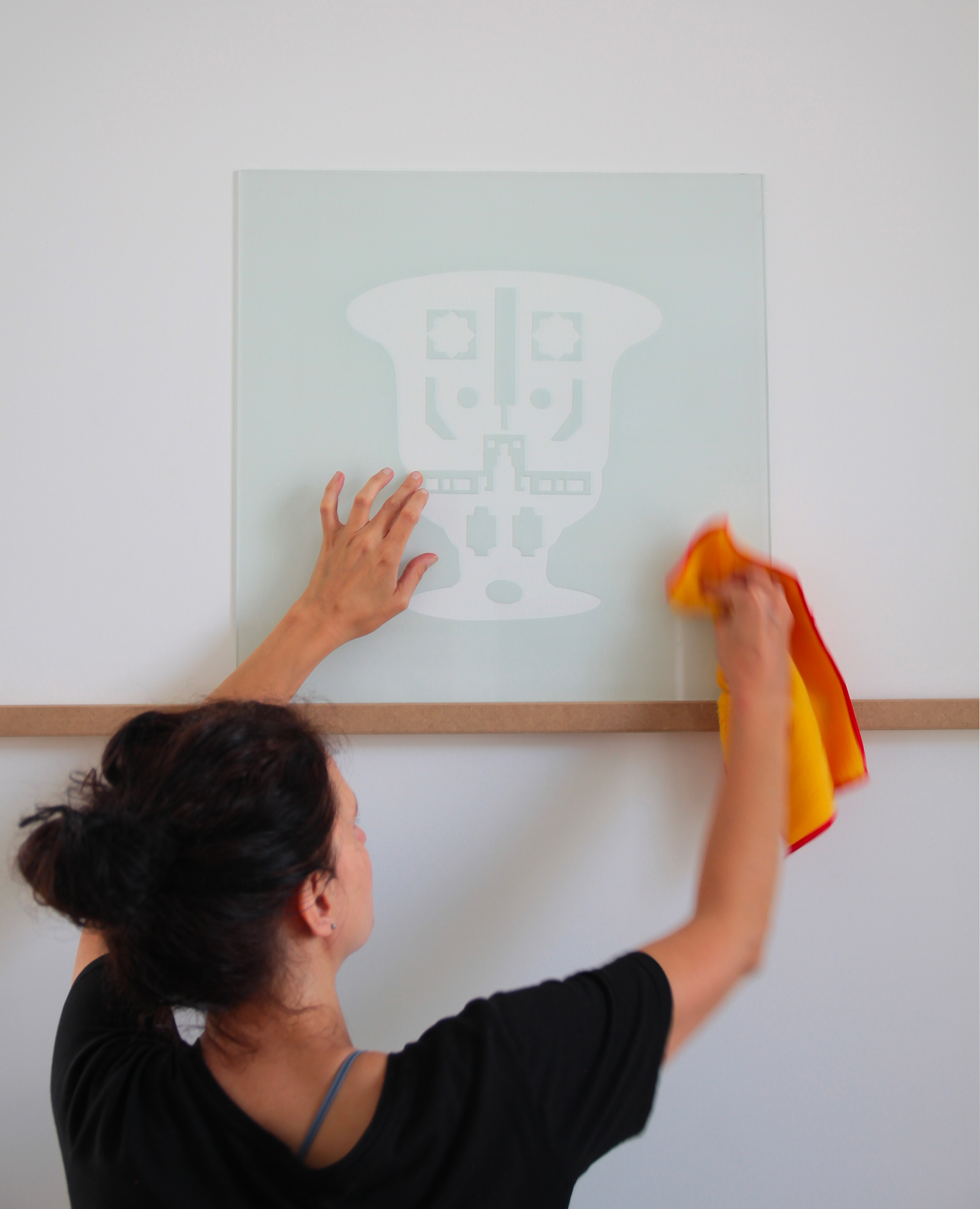
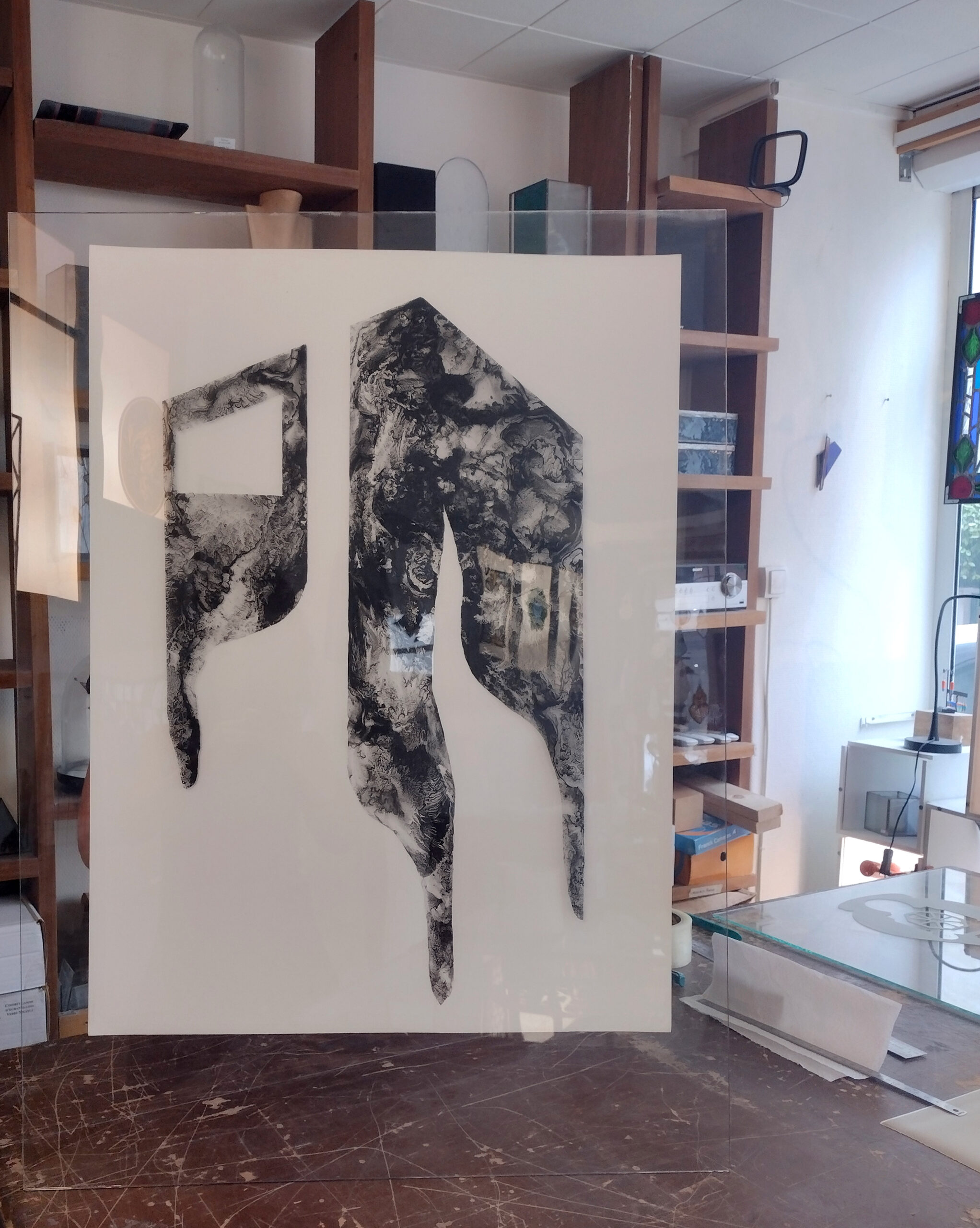
Glass entered my life about fifteen years ago. I am drawn to its many histories, from its composition to the countless ways it has been used over time. Windows through which we look, everyday objects, as well as a material in its own right. We know glass; it is everywhere. Its transparency gives it a discreet presence, allowing the surrounding space to be reflected within it. What I inscribe on its surface enters into dialogue with nearby forms. Light transforms it; it is a rigid canvas in motion. I paint it, sculpt it, engrave it, photograph it.
Grisaille Technique
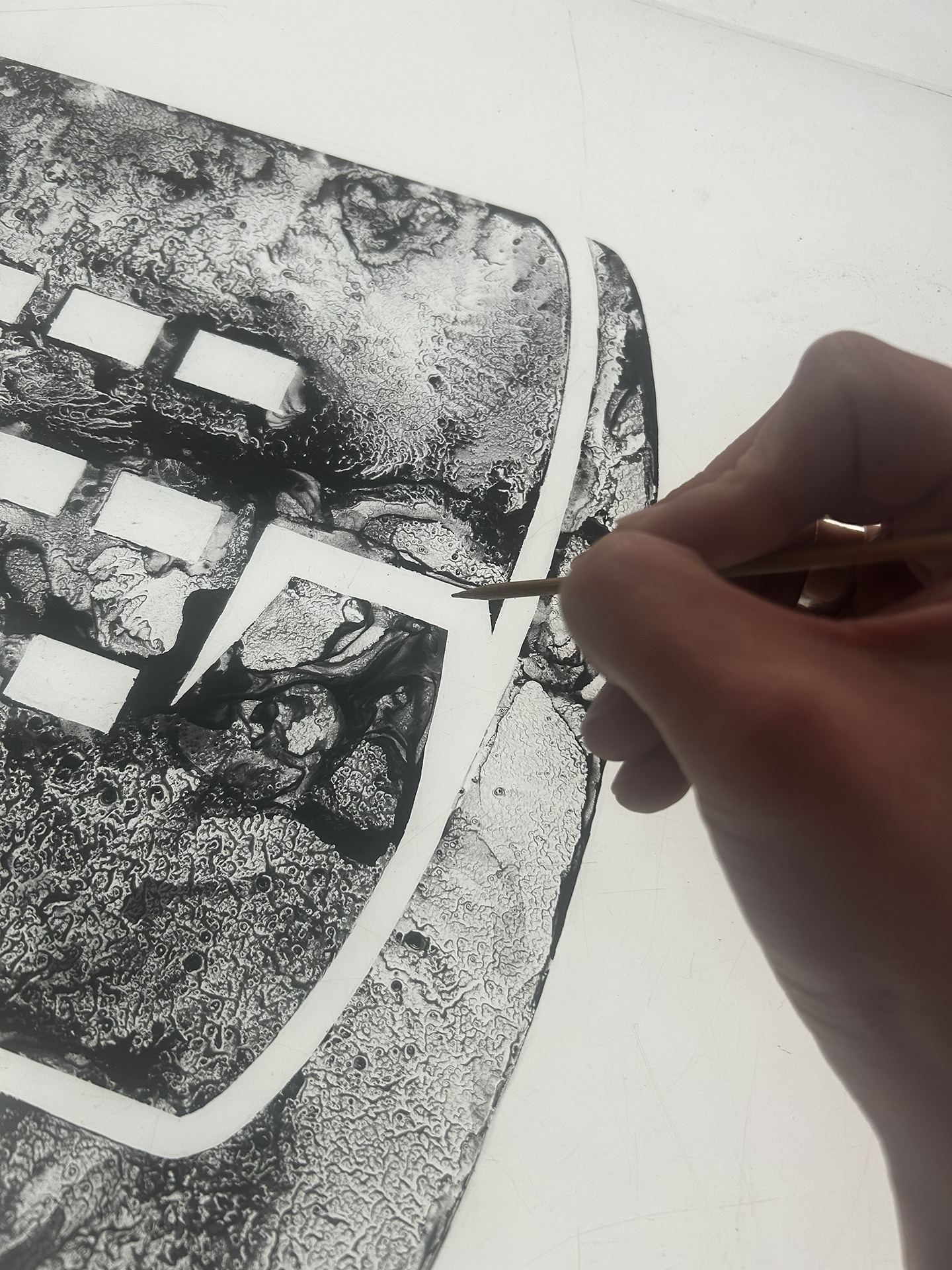
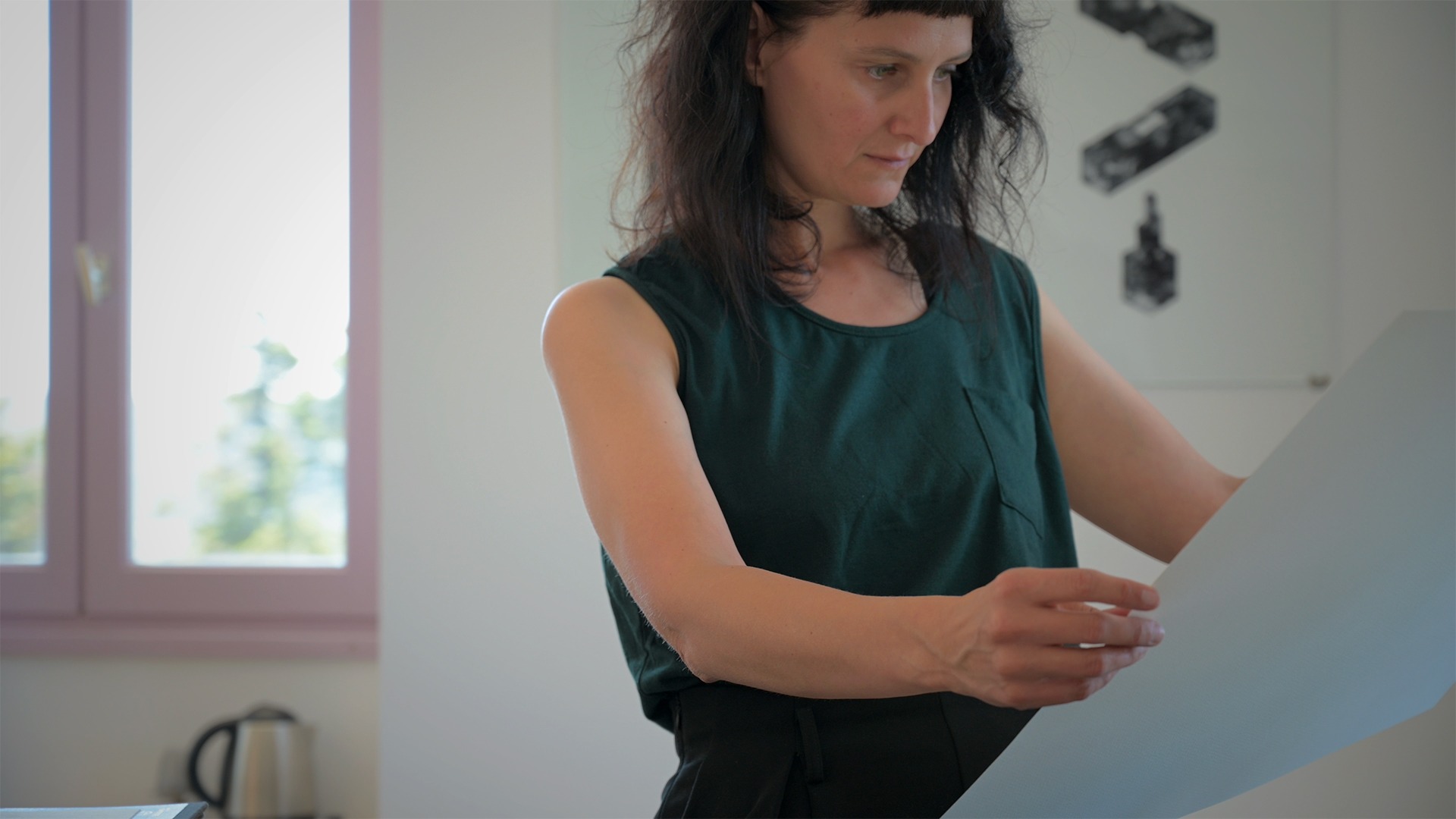
Grisaille is composed mainly of a pigment based on metallic oxides, mixed with a flux, generally powdered glass. This powder is diluted with a liquid to obtain a material that can be applied to the surface of the glass. I work with it in a raw way to preserve its granular quality, which allows for a very high level of detail. I work by removing material in order to reveal the form, much as one might carve a block of stone. The paint is then fired.
Historically, grisaille has been used since the Middle Ages, particularly for faces, drapery, architecture and details in stained glass. For my part, I use it as a form of writing. Through this artisanal technique, I seek to bring in everyday life, memory and the subjects of my research. For me, it retains a sense of mystery and exacting precision throughout the entire making process.
Display
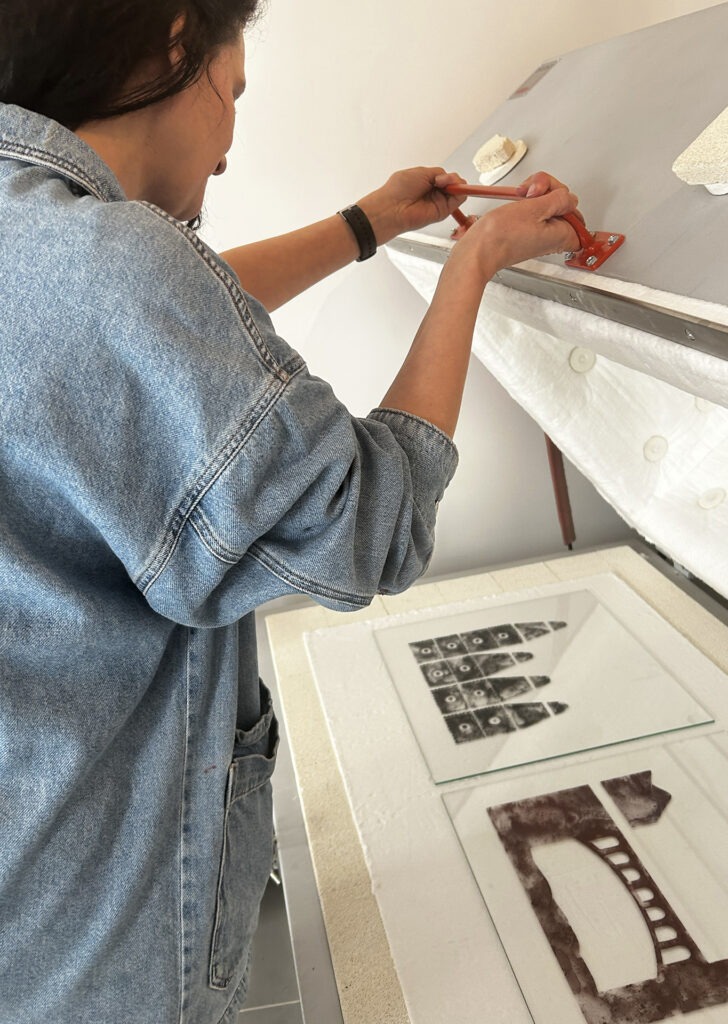
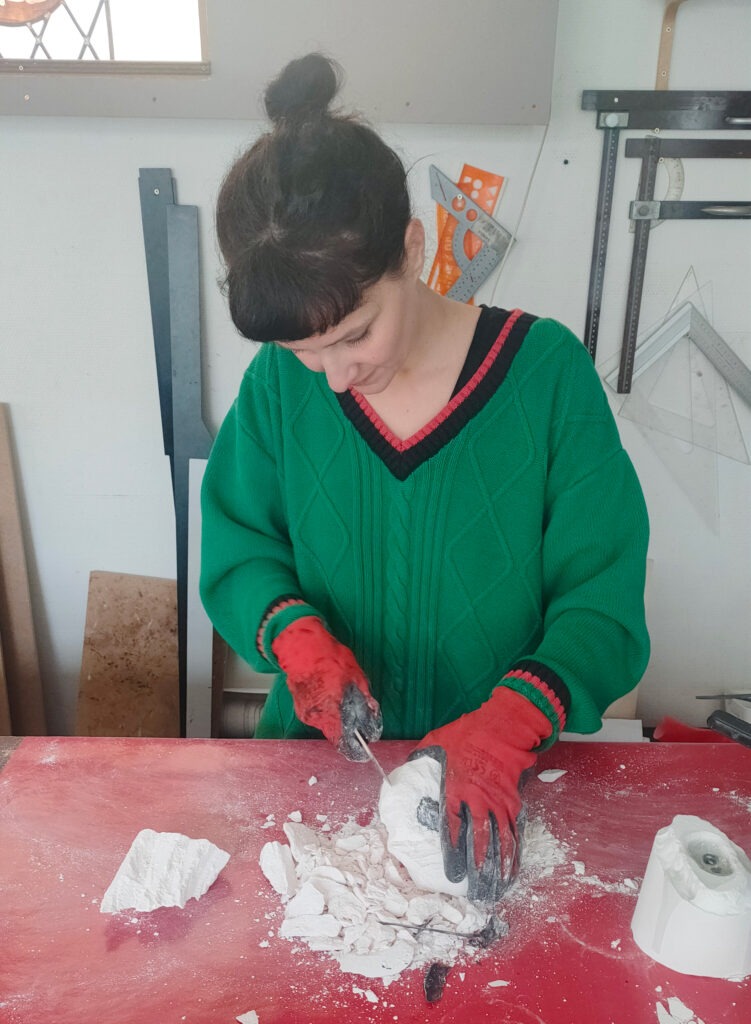
I work alongside craftspeople including carpenters, metalworkers, and architects who help me design and produce custom display structures tailored to each project. I favour wood, whose presence enhances the work on glass. The choice of timber species depends on the specific needs of each project. I am currently exploring combinations of glass and stone for future installations.
Heritage and Matriheritage
I am interested in heritage as something living and constantly shifting. I see the forms that precede us as presences that are still active. I observe them, extract them, and bring them together, sometimes across several centuries or from distant countries, to compose a language of my own. Techniques, architectures, gestures, and objects are never fixed; they continue to circulate, transform, and generate new narratives. My first installation in public space opens up a new field of work that I am excited to explore.
Curriculum vitae
SOPHIE POUILLE
Born in Lille in 1983
Lives and works between Plateau d’Hauteville, Haut-Bugey, and Paris
2026
Manēre, dispersed memorial, Entre les lignes, Espace public de Bellegarde-sur-Valserine
2025
TaraudsDRAC AuRA – AIC – Individual Creation Grant
Penser en dehors du capitalisme, exposition collective,
conférence Marie-José Mondzain, Montagne magique, Plateau d’Hauteville
Rêves d’aoûtgroup exhibition, La Césure, Paris
2024
Rapports de constructions, exposition collective,
Ecole Nationale d’Architecture Paris Val de Seine
30+1group exhibition, Le Cloître contemporain, Lyon
2023
Régolithes, solo exhibition, Atelier Babiole, Ivry-sur-Seine
Battre la campagne, exposition collective, Montagne magique,
Plateau d’Hauteville
Architecture, une hantologie, group exhibition, Les Limbes, lecture by Georges Didi-Huberman, Saint-Étienne
2022
Par ordre d’apparition, artist documentary film, Auvergne-Rhône-Alpes, by Guillaume Robert
2021
Art Fair Dijon, group exhibition
2020
Carbon 20, , group exhibition, Saint-Étienne
2019
Architectures intérieures, group exhibition, École Nationale Supérieure d’Architecture Paris-Val de Seine
2017
Architectures intérieuresgroup exhibition, L’Attrape-Couleurs, Lyon
Espaces intuitifs, exposition collective, Fondation Salomon,
L’Abbaye, Annecy-le-Vieux
Le seuil des chutes, exposition collective,
Centre d’art contemporain de Lacoux, Haut-Bugey
2015
Boites noires empreintes du monde et paysages intérieurs
group exhibition, Planétarium de Vaulx-en-Velin
2014
Cabinet psychophonétique, group exhibition, Galerie Jeune Création, Paris
2013
Formes élémentaires, mouvements et géométries de la pensée
, group exhibition, Espace d’Art Guyancourt
2012
Entropie Néguentropie,
exposition personnelle,
Maison des Mathématiques et de l’Informatique, Lyon
Oeuvres présentes
dans la collection de Claudine et Jean-Marc Salomon
et dans de nombreuses collections privées
2020-2026 : Directrice du Centre d’art contemporain de Lacoux,
Plateau d’Hauteville
2019-2026 Co-fondatrice de Montagne magique,
Plateau d’Hauteville